
Netled CEO Niko Kivioja: 5 Reasons Why Grocers Need Vertical Farming Partners
Walmart recently announced a big bang in the US grocery trade landscape: its investment in vertical farming start-up Plenty. With this, the retail giant is taking a step toward making high-quality, pesticide-free produce more accessible and affordable for the consumer.
What do they know that you don’t? Why should every grocer be scouting for vertical farming partners now and not later?
- The salad and fresh herb markets are growing
 Size does matter, and the size of the market for salad and leafy greens in the U.S. and Canada is approximately $15 billion and growing. And it will continue to grow with an estimated CAGR of 8.2% from 2021 to 2028.
Similar growth is expected in the spice and herb market where in North America alone, it is projected to grow at a CAGR 7.2% (2020 to 2025).
That is a lot of money available for leafy greens, herbs, and spices if you can guarantee your yield and deliveries.
But therein lies the problem.
- Food security
 The COVID pandemic has shown us that the logistics involved in food transportation are extremely susceptible to disruption; perishable products in particular cannot be stored for long before the quality deteriorates to such an extent that they are no longer fit for sale.
The majority of the lettuces sold in North America are grown in California. So, if you buy a packaged lettuce in New York, it has probably already traveled 3000 miles. Any disruptions to this journey along the way only serve to weaken the quality of the product and its availability to the end customer.
In fact, over the past year, packaged leafy greens have been one of the top items missing from grocery shelves due to logistics and transportation challenges.
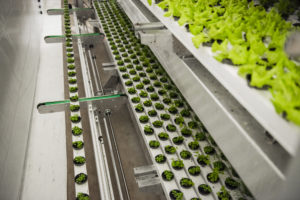
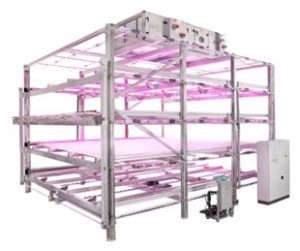
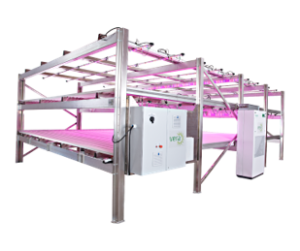
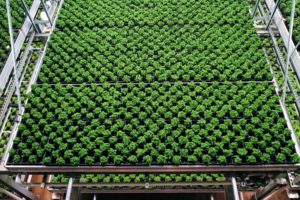
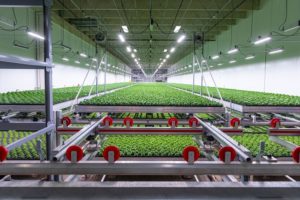
Vertical farming systems like Netled’s proprietary system Vera can ensure the availability of products due to their proximity to the store. A Vera system requires very little space and is significantly more efficient and reliable than traditional agricultural systems.
Vera systems produce:
- 5 times more crops per comparable growing area
- 15 times more per surface area compared to single-level high-efficiency year-round greenhouse growing.
- 100 times more crops per surface area compared to the yield for a normal single season in open-field agriculture.
Vertical farming systems also remove the risks that other forms of agriculture are susceptible to such as unpredictable weather, disease, and pests.
- Food safety
 The more stages there are in the food processing and distribution, the higher the chance of some form of contamination.
Fewer human contact points, precise control over irrigation, and the growing process result in less risk of contamination.
Every year in North America, 48 million foodborne illnesses, 128,000 hospitalizations, and 3000 deaths are recorded. (CDC, 2013).
Bacteria and pathogen contamination in the production line almost always originates from the irrigation water used. Further risk of contamination comes from the washing of field-grown or greenhouse products after they are harvested.
Outdoor farming and most of the greenhouses perform triple-wash on the harvested plants in order to mitigate the contamination risk, as a post-harvest process.
Vera vertical farming systems are encapsulated in a precisely controlled environment where there is no contamination from external sources such as pests, fungi, or bacteria.
The Vera system uses 95% less fresh water for irrigation than open-field agriculture and the water it uses is captured from the plant respiration, purified, and fed back into the system ensuring no possibility of external contamination. The plants are not touched by humans during the growing process and therefore do not need to be washed after harvesting.
Harvesting and packaging can even be automated with robotics so that there is no physical contact with the plant at all.
- Labor costs
 All this automation not only ensures the minimum possible amount of contamination, but it also reduces labor costs.
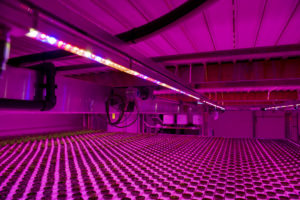
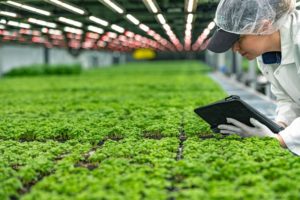
Vera vertical farming systems are less labor intensive in both the growing and harvesting processes. The extremely high level of automation in irrigation, plant spacing, nutrient delivery, and lighting requires less labor resources. Harvesting and packing can also be automated to a high level with the help of AI and robotics, and if the vertical farm is situated in close proximity to the store, logistic, and transportation costs are also reduced dramatically.
- Quality
Awareness and demand for healthy plant-based foods is growing. Salads are a good source of fiber, iron, calcium, potassium plus vitamins A, K, C, and E.
There are many factors that can affect the quality of the end product, not only in the processing stages of production, but also in the growing stage. Open-field growing is particularly susceptible to risk factors: extreme weather events such as torrential rain and drought, nutrient depletion and salination of the soil and the chemical fertilizers used to attempt to redress the balance, water infiltration rates, pesticides, herbicides, and chemical spraying to name a few.
Vertical farming systems operate in a precisely controlled environment where every last detail is planned, monitored, and controlled from seed to retail. There are no rainy days, no hot days, no pests or chemicals – everything is always just right
The Vera system is programmed according to the particular plant and the variables are adjusted so that it can grow to its own genetic maximum. This results in the highest possible quality with guaranteed results no matter what time of year or whatever the weather.
—
In case you’d like to learn more about your potential future vertical farming partner, come and meet Netled CEO Niko Kivioja and the rest of the team at Indoor AgCon booth 1023!
Niko Kivioja will also join a panel conversation on Direct Controlled Environment Agriculture Farming in Grocery Stores, Hotels & Restaurants on Monday, Feb 28th at 4:00 pm.
TO LEARN MORE ABOUT NETLED AND ITS VERA TECHNOLOGY:
W: NETLED.FI
NETLED VIDEO RESOURCES:
Introduction to Vera vertical farm
Netled featured on Advancements TV Series aired on CNBC

 Indoor Ag-Con
 Congratulations on the recent news about the $120 financing arrangement with The Decennial Group. How does this play into your growth plans?
 Speaking of news, can you also share a little more about the new partnership between Soli Organic and Rutgers University and how you will be working with its plant breeding experts?
 What’s next for Soli Organic?


 New product line is 40% lighter while retaining trusted strength and durability of MFG’s fiber glass reinforced composite.
 >>Dimensionally stable and exceptional structural strength

 From the beginning,
 We founded the company to miniaturize the semi-automation found in commercial-scale farms, at a fraction of the cost and designed it to be controlled via the cloud to allow for aggregated data collection.Today we’ve built and deployed that underlying technology on our fleet of distributed Micro-Farms in North America. We’re just getting started in our journey to apply our underlying technology to different vertical farming systems and in doing so expand the market for sustainable indoor farming.
 We’re accelerating the commercialization of indoor farming service with hundreds of Micro-Farms being installed in foodservice operations across North America. We’re confident in our technology’s ability to deliver an unparalleled growing experience and it’s exciting to see the data coming in from our growing base of happy customers.


 Our goal has always been to make vertical farming accessible to mainstream markets. We’re proving that it’s commercially viable with our foodservice partners and simultaneously we’re seeing the rapid expansion of the local food movement that’s driving a ton of innovations in the CEA space.


 It’s been a fantastic year for us! We opened our largest automated farm in the Fall of 2020, scaling our technology and production 10x greater than prior. Yield, quality, and efficiencies exceeded expectations out of the gate and allowed us to hit our unit economics.

 Retailers and consumers have a growing appetite for fresh food grown indoors. Retailers want fresher food with shorter supply chains to significantly reduce supply inefficiencies, inconsistent quality and reduce food waste. In addition, consumers are more aware of how their food is grown and its effect on the environment. Therefore, they want food grown with zero, not fewer, pesticides with the highest nutritional value and grown close to store for longer-lasting freshness.

