
Skytree Introduces Latest Direct Air Capture Unit for CEA At Indoor Ag-Con 2024
Amsterdam and Indoor Ag-Con, Las Vegas, NV – March 11, 2024 – Skytree, a pioneering climate tech company specializing in carbon utilization and removal solutions, today announced the availability of Skytree Stratus, the company’s newest decentralized Direct Air Capture (DAC) unit for onsite carbon capture and utilization. The Skytree Stratus unit can generate as much as 2750 lbs. (1250kg) of CO2 per day to meet the needs of large greenhouses and vertical farms.
Stratus is Skytree’s second decentralized DAC unit brought to market in the last seven months, following the launch of the smaller scale Skytree Cumulus launched last fall. Cumulus units are currently generating CO2 at CEA facilities around the world including Wageningen University & Research Center in The Netherlands.
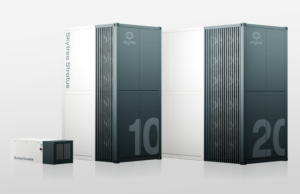 Once installed onsite, Stratus captures CO2 from the ambient air to be deployed to enrich crop yield and increase productivity. The fully modular nature of Stratus allows for multiple units to be combined into a “Skytree Stratus Hub” to meet larger volume needs. Through partnerships, Skytree offers local liquefaction of CO2, required for storage of liquid CO2, enabling CEA businesses to continuously capture and store CO2 in use during peak production periods.
Stratus is available in hybrid and all-electric-powered configurations, designed to optimally integrate with the location’s onsite energy source. The dual-powered Skytree Stratus Hybrid uses onsite thermal heat which reduces the need for electricity, delivering considerable savings as compared to the all-electric version. Over time, Skytree expects to drive Stratus’ energy consumption to under 1kWh per kg of CO2 generated.
“Following the successful commercial launch of the Skytree Cumulus, we are excited to debut our much larger Stratus system with shipments starting later this year,” said Rob van Straten, Skytree CEO. “The introduction of Stratus reflects our great momentum and the strides we continue to make in providing CEA businesses with an innovative alternative to fossil fuel-based CO2. CEA businesses facing or expecting supply chain challenges and price instability want an independent and continuous supply of CO2,” van Straten continued. “Stratus offers a reliable CO2 source for businesses seeking to boost crop yield while, at the same time, securing supply, and reducing carbon footprint.”
Through the company’s Uptime Assurance Guarantee program, Skytree guarantees high uptime, monitors, and measures CO2 generation, and conducts all preventive and corrective maintenance to ensure uninterrupted operations.
For more information about Skytree Stratus, click here:
About Skytree:
Founded in 2014 and headquartered in Amsterdam, Skytree harnesses CO2 from ambient air through the power of direct air capture technology (DAC). By providing local, onsite CO2 generation across multiple markets including vertical farming, greenhouses as well as mineralization, Skytree enables a transition away from fossil fuel-based industrial processes and avoids transport to where the CO2 is needed.
Born out of the European Space Agency (ESA), during the development of a CO2 scrubber, space scientists evaluated over 50 sorbents. Skytree founder, Max Beaumont, was a system engineer on this team and spun out the technology through the ESA incubator program ‘ESA-BIC’. With a decade of research & development, the company has since registered 17 patents, in 5 patent families across US, Europe, and China and is ready to monetize the technology through multiple use cases.
The Skytree Stratus initially is focused on high tech greenhouses that require large volumes of CO2 with initial customers in The Netherlands, Canada and United States.