Moderated by Paul Brentlinger, CEO of CropKing, the panel will feature:
John McMahon, CEO of Equinox Growers
Carl Gupton, CEO of Greenswell Growers
These Virginia-based leaders will share their firsthand experiences integrating automation technologies into their growing operations. From climate and fertigation controls to robotics and real-time monitoring systems, panelists will offer candid perspectives on what’s working, where the challenges are, and how technology is improving operational efficiency — without losing the human touch that defines successful growing.
“This panel is a true reflection of the mission behind CEA Summit East — bringing research and real-world practice together,” said Brian Sullivan, CEO of Indoor Ag-Con. “Our Day 2 keynote gives attendees a chance to learn directly from growers who are actively testing and scaling automation on the ground.”
Dr. Scott Lowman, Vice President of Applied Research at IALR and Co-Director of the CEA Innovation Center, added, “There’s a lot of hype around automation, but what’s most valuable to our attendees is seeing how it’s actually being implemented in real-time by growers in Virginia. This session will give them that clarity.”
This keynote follows the Opening Day Keynote on September 9: “Cultivating Sustainable Growth: Balancing Economics and the Environment in CEA” moderated by Inside Grower magazine’s Jennifer Polanz, and featuring participants, including Matthew Lohr, Virginia Secretary of Agriculture and Forestry, and Ben Alexander, Project Director, Oasthouse Ventures.
ABOUT CEA SUMMIT EAST
Co-hosted by Indoor Ag-Con and the CEA Innovation Center—a partnership between IALR and Virginia Tech—the CEA Summit East returns September 9-10, 2025, for its fourth edition. The event offers two days of educational sessions, tabletop exhibits, networking, research showcases, and tours of the CEA Innovation Center, all designed to bring together stakeholders from across the indoor farming industry. Attendees include greenhouse growers, urban agriculture operations, vertical farms, outdoor growers exploring hybrid opportunities, educators, scientists, extension specialists, suppliers, engineers, tech specialists, architects/developers, government officials, and other industry members.
For more information on the CEA Summit East and to register for the event, please visit www.ceasummit.com
ABOUT INDOOR AG-CON
Founded in 2013, Indoor Ag-Con is the largest trade show and conference for greenhouse, controlled environment agriculture and vertical farming. The event covers all crop types and brings together growers, tech providers, researchers, and business leaders to explore trends and innovations shaping the future of food production For more information, visit www.indoor.ag.
ABOUT THE CEA INNOVATION CENTER
The Controlled Environment Agriculture Innovation Center is a joint project between Virginia Tech, the Institute for Advanced Learning and Research (IALR), and industry that is working to advance the controlled environment agriculture (CEA) sector in Virginia, the U.S., and internationally through leveraging its collective resources, skills, and expertise by addressing the needs of the industry with research, education, and extension programs For more information, visit www.ceaic.org
Water Garden Farms (WGF), Siemens, and CEAd have announced a partnership to integrate cutting-edge AI and fully automated precision agriculture technology in WGF’s indoor farming operations, paving the way for a new era in crop production that ensures food and water security and expands access to more affordable, higher-quality produce.
This alliance will fast-track the rollout of WGF’s high-yield, low-cost, environmentally sustainable, and decentralized farming model – starting with the construction of a new 500,000-square-foot, solar powered greenhouse facility in West Virginia.
Strategically located near Washington, D.C., this state-of-the-art facility will be the world’s most technologically advanced greenhouse operation of its size, producing 35 million packaged salad units annually, using a fraction of the resources required by open field farms.
Powering the Future of Agriculture: Inside the Siemens-CEAd-WGF Alliance
Siemens Digital Industries, a global technology powerhouse, provides the foundational technology architecture and cutting-edge digital tools that make scalable, high-performance Controlled Environment Agriculture (CEA) operations possible. Through its advanced Siemens Xcelerator open business platform, Siemens enables seamless development and integration of hardware and software, driving real-time insights, operational precision, and continuous innovation.
digiCEAd is a joint platform established by Siemens and CEAd. digiCEAd delivers tailored digital solutions built specifically for CEA operators. By combining Siemens’ technology ecosystem with CEAd’s deep industry expertise, digiCEAd enables WGF to adopt digital twin modeling, AI-driven analytics, and comprehensive operational management tools. This ensures not only food safety excellence and regulatory compliance, but also continuous operational improvements and scalable growth.
Water Garden Farms is providing digiCEAd a strategic platform to deploy its leading AI, automation, and monitoring capabilities, while enabling Siemens and CEAd to support WGF’s operational growth. WGF is on a mission to revolutionize agriculture production through a high efficiency farming model that maximizes crop yields and quality, while minimizing water and energy consumption. WGF’s new flagship facility in West Virginia marks the first phase of a $500 million multi-site expansion across the U.S. These next-generation greenhouses aim to set a new global standard for indoor farming and environmental and social impact.
Water Garden Farms Flagship Facility – West Virginia, USA
“Together, we’re setting a new global benchmark for food quality, crop productivity, affordability, and environmental sustainability,” said Dennis Levine, Founder & CEO of Water Garden Farms. “With digiCEAd and Siemens’ cutting-edge AI, control, and automation systems, and CEAd’s leading facility design capabilities, we’re deploying a high-yield, climate-resilient production model that dramatically lowers the cost to market of nutritious produce to help combat food inflation, expand access for consumers, and drive positive environmental and social impact at scale.”
“Building resilient and scalable food systems requires collaboration. By partnering with technology and business leaders like CEAd and WGF, we can develop disruptive smart farming solutions that will transform the CEA industry,” said Rick Schneiders, Head of Future Food at Siemens. “The CEA industry stands at a pivotal moment, where embracing open, scalable solutions is essential. By harnessing vast amounts of data to gain deeper understanding and actionable insights, we can drive down costs and increase production. Our goal is to support the CEA industry in making this crucial transition in the coming years.”
“This collaboration is more than a technological partnership; it’s a bold reimagining of how we grow food now to meet future challenges,” said Thomas Larssen, CEO of CEAd. “At CEAd, we’re committed to delivering facility designs and operational systems that don’t just meet today’s challenges but set new standards for efficiency, resilience, and sustainability. Together with Siemens and Water Garden Farms, we’re creating an ecosystem where cutting-edge technology and practical design converge to produce high-yield, low-impact, and future-ready agriculture.”
This innovative collaboration is not just about technology; it’s about completely rethinking how agriculture meets the demands of the future by creating systems that set new benchmarks in sustainable food production. WGF’s innovative farming model far surpasses traditional agriculture methods by enhancing food quality and safety, optimizing unit economics, using 98% less water, reducing carbon emissions by 84%, and delivering 44 times higher crop yields per acre compared to open field farms in water stressed California and Arizona, which supply 90% of U.S. leafy greens.
About Water Garden Farms
WGF is pioneering a new era of sustainable agriculture by tackling the urgent challenges of extreme weather, resource scarcity, and global food insecurity. Headquartered in New York City, WGF is redefining food production by optimizing operational efficiency and competitiveness to drive positive environmental and social outcomes. WGF’s breakthrough farming model combines world class finance expertise and business leadership with ultra-efficient production systems, smart logistics, and advanced marketing strategies to deliver fresher, higher-quality produce at a lower price – reaching retailers within hours of harvest.
WGF’s mission is to build a more resilient and environmentally responsible food system by cutting carbon emissions, reducing supply chain waste, minimizing resource use, and maximizing food safety and accessibility. Through a focus on innovation, rapid crop rotation, and cost efficiency, WGF creates value for consumers, retailers, shareholders, and the planet – setting a new standard for local, sustainable, and scalable food production.
About CEAd
CEAd’s team of project managers, engineers, designers, and industry professionals specialize in technical consulting services for the controlled environment agriculture industry. With over 35 years of experience developing facilities worldwide, CEAd works collaboratively with its clients and extensive vendor network to provide tailor-made solutions that are scalable, resource-efficient, and future-ready.
About Siemens
Siemens AG (Berlin and Munich) is a leading technology company focused on industry, infrastructure, mobility, and healthcare. The company’s purpose is to create technology to transform the everyday, for everyone. By combining the real and the digital worlds, Siemens empowers customers to accelerate their digital and sustainability transformations, making factories more efficient, cities more livable, and transportation more sustainable. A leader in industrial AI, Siemens leverages its deep domain know-how to apply AI – including generative AI – to real-world applications, making AI accessible and impactful for customers across diverse industries. Siemens also owns a majority stake in the publicly listed company Siemens Healthineers, a leading global medical technology provider pioneering breakthroughs in healthcare. For everyone. Everywhere. Sustainably.
In fiscal 2024, which ended on September 30, 2024, the Siemens Group generated revenue of €75.9 billion and net income of €9.0 billion. As of September 30, 2024, the company employed around 312,000 people worldwide on the basis of continuing operations.
There’s an emerging wave in the approach to farming all around the world, and it’s very evident at CES 2025. Several companies are represented by their home countries on the convention floor to demonstrate how they’re becoming leaders in the agritech movement, particularly in the way we can implement AI to grow crops more efficiently.
Based on its prominent presence at CES, it’s clear that South Korea, more than any of the dozens of countries and regions represented, is prioritizing getting younger generations into farming by making it more appealing to them. The country is pushing to integrate AI into vertical farming and using innovative techniques like robotics and automation to make it possible in urban areas. These AI technologies are collecting so much data that it’s bound to reduce human error and make many components of farming a lot easier to manage.
Launch of Sweden’s Largest In-Store Farm With Swegreen
Construction has officially begun on Sweden’s largest in-store farm at ICA Maxi Ängelholm. Powered by Swegreen’s Freja platform, this innovative farm will allow the store to produce over 160,000 leafy greens and herbs annually. By growing crops directly inside the store, ICA Maxi aims to offer customers a steady, hyper-local supply of sustainable produce without the typical price fluctuations.
Freja Platform: A New Standard for Sustainable Farming
Swegreen’s Freja platform is the most advanced in-store farming solution available globally, using vertical farming and AI technology to grow crops with minimal environmental impact. In a space of just 45 to 60 square meters, the Freja platform can produce up to 450 crops per day, including lettuce, leafy greens, and herbs. With no transportation required, carbon emissions are significantly reduced.
Pierre Mohlin, CEO of Swegreen, commented, “The Freja platform at ICA Maxi Ängelholm will not only be the largest in-store farm in Sweden, but it also sets a new global standard for sustainable, hyper-local food production.”
Whether you grow ornamental crops, cannabis or greenhouse vegetables there are numerous companies that are promising to optimize processes, increase efficiency, and improve overall crop yields. After having many conversations with growers in greenhouses, vertical farms and other indoor (and outdoor) growing facilities, Christopher Higgins & the Urban Ag News team put together a short article outlining the types of technologies being proposed and their capabilities at this stage in the product development process.
The way they see it, there are five types of “AI” terminologies/technologies being marketed, developed and used in some form or fashion: Digital Twins, Generative AI, Intelligent Algorithms, Sensing/Computing Vision and Robotic.
Based on the research the Urban Ag Newsteam has access to, including websites of businesses targeting commercial horticulture and controlled environment agriculture, they see companies using these five types of AI to enhance the following functions…
AGEYE will Assume Sales, Installation, and Support of HYVE Systems Moving Forward
(Raleigh, North Carolina – March 11, 2024) AGEYE, a forefront innovator in AI-powered crop intelligence for controlled environment agriculture (CEA), proudly announces its strategic acquisition of the HYVE® brand from DASCOM Americas. The company will also assume leadership roles for sales, installation, and support of HYVE systems moving forward. This pivotal move, an extension of the partnership that started in 2022, merges AGEYE’s leading AI technology with HYVE’s scalable, automated vertical farming system, and provides a clear and focused team and direction that will bring undistracted attention in providing the best, most comprehensive system for commercial farming operations.
Nick Genty, CEO of AGEYE, highlighted the industry’s challenges: “Vertical farmers often struggle with piecing together disparate solutions from various providers, leading to inconsistent results. Some have attempted to develop their own technologies, usually facing limited success and budget overruns. We’ve taken a fundamentally unique approach, combining task-specific yet straightforward technologies to provide a comprehensive, superior alternative that has already demonstrated success in the market.”
Central to this innovative solution is the automation of the entire plant lifecycle, from seeding to harvest. Efficient and practical robotics technology significantly reduces human errors, improves plant health, and lowers labor costs, all without the substantial financial investment typically required by advanced technologies. Enhanced by AGEYE’s sophisticated analytics and crop monitoring, this automation supports informed, data-driven decisions across all farming operations – from irrigation and nutrition to lighting, climate control, and harvesting, setting a new standard for the industry. The comprehensive solution is designed to address the real-world challenges faced by vertical farmers, aiding in lowering operational expenses and growing cost-competitive crops.
“The acquisition of the HYVE brand and day-to-day leadership underscores our commitment to advancing indoor agriculture through technology,” said Bashir Jabbour, Senior Director of Product at AGEYE. “Our turnkey solution, where every component is precisely designed to work together, simplifies the journey to success for growers in a competetive landscape. This cohesive approach allows growers to focus on their primary skill: growing. It spares them the complexity of managing multiple vendors and accelerates the operational setup.”
According to Ron Acorn, President of DASCOM Americas: “AGEYE and HYVE have worked together in a strategic capacity over the course of the last several years. Nick is a seasoned leader, full of energy, and very focused with a
team that is well positioned to take HYVE to a new level. This deal comes at a very opportune time for both companies. AGEYE is geographically and strategically well-positioned to maximize the capabilities of a more full- scale integration of the specific abilities of both companies. The combination of the system infrastructure we have cultivated to this point combined with their superior technology leadership means that there is now one source with a fully focused vision to give commercial growers the most viable and comprehensive pathway to success in their indoor farming pursuits. It is both strategic and practical for AGEYE to assume a more prominent role in bringing this comprehensive solution to market. AGEYE’s leadership, technical expertise, and depth of experience add the final missing piece to an unmatched recipe for prospective indoor farmers who will without doubt change the landscape of commercial farming moving forward.”
This move marks a significant step in AGEYE’s effort to transform vertical farming into a well-known, dependable, and financially viable way to grow crops all year, moving it from a niche method to a widely accepted, sustainable form of agriculture. The goal is to make advanced crop intelligence and automation technology accessible to indoor farmers of all sizes, enhancing their productivity and ensuring sustainable and continuing operations.
For More Information:
To learn more about our solutions and technologies, please visit our websites: AGEYE Technologies:https://ageyetech.com
AGEYE specializes in advanced farm management software, IoT devices, AI-driven crop analytics, and fully automated robotic solutions for vertical farming. Our focus is on enhancing revenue per square foot using data- driven precision agriculture. We’re dedicated to making indoor farming viable and profitable by embracing sustainability and leveraging intelligence to simplify complexities. Our technology empowers indoor growers to transform challenges into opportunities, setting new standards for the future of controlled environment agriculture.
About HYVE:
HYVE is a business unit of DASCOM Americas which serves the Americas markets and is wholly owned by DASCOM Holdings, a Hong Kong-based company with more than 30 years of experience in providing technology solutions. The company does business in more than eighty countries around the globe and offers diverse solutions for customers in a broad range of markets.
For each demo of its innovative SUN as a Service® platform performed during the event, Sollum® pledged to donate $ 100 USD directly to Three Square. On the second day of the show, Sollum donated $ 3,000 USD, which will contribute to serving approximately 9,000 meals.
Sollum Technologies designed the only 100% dynamic LED lighting solution that modulates the full spectrum of the Sun’s natural light to illuminate closed environments such as greenhouses, research centers and laboratories. Sollum’s award-winning, turnkey solution consists of internet of things, AI-powered light fixtures that are controlled by Sollum’s proprietary SUN as a Service® cloud platform.
Sollum’s distinctive proposition is a fully scalable cleantech solution that evolves with business needs and multi-zone light management, with each zone benefiting from automatic dimming of an unlimited number of light recipes; this is why it provides unparalleled value in terms of energy savings and, additionally for greenhouse growers, increased productivity and superior produce quality.
ABOUT SOLLUM
Founded in 2015, the company is headquartered in Montréal (Québec, Canada), where its design, development, and manufacturing activities are concentrated, and has a representative office in Leamington (Ontario, Canada). For more information, visit sollum.tech.
Indoor Ag-Con media partner iGrowNews, a prominent news platform renowned for its extensive coverage of industries within the agriculture sector, has launched a new Market Research Division.
This new division provides tailored market research services based on each client’s unique needs and challenges. Leveraging the expansive database they have amassed over the years, iGrow News aims to offer unparalleled insights spanning various industries such as Controlled Environment Agriculture (including Indoor Farming, Vertical Farming, Greenhouses, and Container Farming), Robotics & AI in Agriculture, Crop Nutrition, Crop Protection, Agriculture Machinery & Equipment, Farm Management Software, and Sensors & IoT in Agriculture.
In the age of data-driven decision-making, iGrow News’ decision to launch this division reflects its ongoing commitment to meet the evolving needs of its clients. “We have always strived to bring relevant news and information to our audience. With this new division, we are taking it further by providing actionable insights derived from a deep analysis of our vast industry data. This move positions us as a news platform and a strategic partner for businesses,” says Sepehr Achard, CEO of iGrow News.
The Market Research Division will utilize the latest techniques and methodologies in data analysis to provide actionable market insights, in-depth reports, and strategic recommendations. This will equip clients with the knowledge they need to make informed decisions and stay ahead in their respective markets.
iGrow News invites all interested parties needing tailored market research services to reach out and explore how this new initiative can meet their unique needs.
iGrow News is a leading news platform specializing in the agriculture technology sector. They deliver industry news and information, helping professionals stay updated on current trends and developments. With its new Market Research Division, iGrow News is set to offer more personalized services to businesses, contributing to strategic planning and informed decision-making.
As the indoor farming industry continues to grow, the need for profitability remains a significant challenge for commercial growers. AGEYE Technologiesis helping lead the way in automated platform monitoring for vertical farms and greenhouses and CEO Nick Genty provides insight into how they are addressing this challenge, as well as their advancements in AI and machine learning. In this month’s CEO Q&A Nick also talks about AGEYE’s new partnership with HYVE Indoor Farming Systems, their recently announced indoor farm project in Nebraska and future growth plans.
What is one of the biggest challenges facing the indoor farming industry today and how is AGEYE working to address it.
The most significant challenge we see is the need to reach profitability. We’ve all seen the recent headlines of farms shutting down, being delisted, or going through intensely difficult and desperate financial times. We’re starting to see that for many stakeholders, the hype is waning, the honeymoon is over, and investors want to see a return on their investment – or at least a very substantive and believable path to it. For CEA to truly become commercially viable and scalable, farmers need systems and support that help them produce a marketable product in a reasonable timeframe, and with enough margins to see a profit. As an industry, we need to focus more on celebrating the farms that reach profitability and less on how much money has been raised.
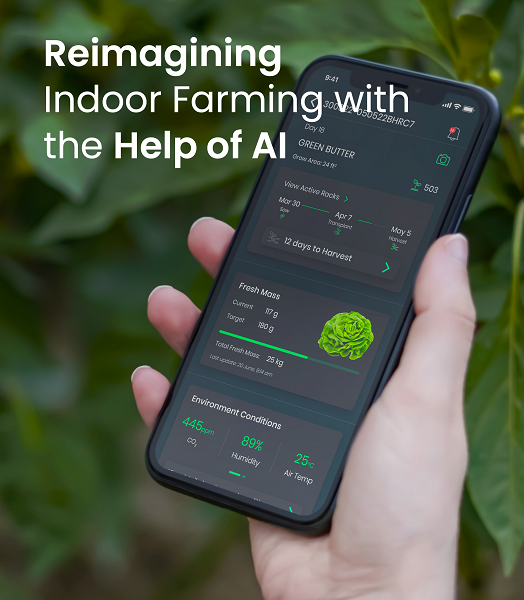
How does AGEYE stay ahead of the curve when it comes to advancements in AI and machine learning, and what impact do these technologies have on your monitoring platform?
AI is evolving faster than any other technology we’ve ever seen. Generative AI like ChatGPT can produce an entire screenplay or write the code for a new app in a matter of minutes. However, the current version is already being replaced with an even more powerful version, GPT-4, which is said to be capable of creating full movies from simple text prompts. This massive jump in performance is due to a 10x increase in data parameters used for training. At AGEYE, we believe the future of indoor farming is data-driven, and our commitment to this goal drives everything we do. In 2019 we started training our vision models to detect crop stress. Fast forward to today, and we’ve expanded our AI platform to cover every aspect of an indoor farm. We’re collecting thousands of data points per plant, per cycle, that we aggerate with environment, energy, and labor data to produce powerful insights and unprecedented visibility across an entire operation. We’re empowering growers with the technology and tools they need to become efficient, sustainable, and, most importantly, profitable.
Can you tell us more about the partnership between AGEYE and HYVE Indoor Farming Systems- – How did this collaboration come about and what are the main benefits the partnership will bring to commercial growers?
Our first introduction actually happened at a previous Indoor Ag-Con. There are a lot of moving parts in this industry, and things change so rapidly. It’s easy to be sucked in by what might turn out to be smoke and mirrors, but there was something about our initial meeting with HYVE that led us to believe there was substance backed by significance and passion.
The combination of automation, crop intelligence, exceptional hardware and lighting – it all seemed like it was there. It was evident that we both had tangible evidence and proof of concept for what we could do on our own, but more importantly, together. Collaboration has often been a theme in this industry and we could see early on that we complemented each other well in areas where one might not be as strong as the other. We both had experiences apart and we shared and leveraged those experiences on an early trial project together. This project proved to us both that we really felt that the sum of our parts was greater than what it should have been – almost like adding 1 + 1 to get 3.
For our customers and prospects, the main benefits are just immense. We believe that we have a revolutionary turnkey system that combines the absolute best in hardware, lighting, infrastructure, software, and AI controls and monitoring. These are some very tangible attributes. What we also think is a huge benefit is our flexibility in what we do. We have scalable systems and feel invested in the commercial farmer as if it were our own money. We see a pathway to profitability for the commercial farmers we work with by being a ‘right-sized’ entity with experience to back what we say we can do. Our methodology removes much of the guesswork and mitigates some of the risks that growers encounter. It’s really an exciting time to be invested together in a partnership where we share such diverse talent sets, system integrity, and vision for what indoor farming can become.
What challenges do you anticipate in building the new indoor farm in Nebraska, and how will AGEYE work with HYVE to overcome them?
There are some very fundamental challenges that come with any installation, and while each installation is a bit different, many things we see are common. In the Nebraska installation, we will be retrofitting an existing building. This is quite common. One could argue that an optimal vertical farm would be created in a building specifically designed for vertical farming because everything from airflow to automation and intelligence would fit perfectly into a well-designed and very intentional space. This removes some of the challenges of altering what can sometimes seem like a square peg that needs to be implemented into a round hole. But, realistically speaking, there are real benefits to also retrofitting an existing building. We’re good enough at understanding what has to happen to know if it can successfully happen. A perfect building might be beyond the reach of many people who want to enter vertical indoor farming, while an existing space might mean that someone doesn’t need tens of millions of dollars to set up a successful indoor commercial farm. Repurposing buildings has an inherent appeal in that you are taking something that could be non-productive and turning it into something very productive at a cost point that makes sense for the owner and can create something beneficial in terms of actual production or job creation.
One of the very essential things we seek to do is to create a system that can produce a saleable product for our customers each and every day in a cost-effective way. The process has to be repeatable and successful. Profitability is always the challenge and without good market data and an efficient distribution methodology that includes an understanding of the market, there isn’t a way to get there. We’re not in the business of just selling equipment so that people fail. For this reason, we will be assisting the client in Nebraska with some expertise in understanding the market opportunities. We will help them look at the product mix and provide relevant data that puts them on a path to see a return on their investment.
Looking ahead, what other types of project or collaborations do you see as possibilities for AGEYE and HYVE and how do you envision your partnership evolving in the future?
AGEYE and HYVE are both really good at very distinct and yet dissimilar things that together can produce great results. One of the things we talked about even early on was how we were both so innovative and solutions-based, which we highlight in our joint tagline of ‘Matched Innovation. Unmatched Solutions.’ We believe that together we can offer solutions that others really can’t, and much of it is not only the very real and measurable tangible evidence of our quality and system intelligence but also the passion and knowledge of the people involved.
Looking forward HYVE will include the AGEYE platform as a very critical and integrated piece of the puzzle for growers. We’ll look at each individual project and see where the marriage of automated functionality and artificial intelligence makes both logistical and financial sense for the grower and our respective companies.
We also will likely look at each respective strength and ability in the stand-alone entities. For instance, it might make sense for one entity to capitalize on technical support from the other because of specific expertise that resides within a certain sector. We truly believe that at the end of the day, our common mission is about creating a system that makes the most sense for the grower in an economic and qualitative sense.
Take one step into any indoor agriculture convention or expo and you will immediately see how the industry has transformed over the past several decades. With new products and devices that claim to solve each and every problem you may have, from drones running your IPM to AI software managing climate controls, the options and solutions can seem to be endless. As a new grower or even a seasoned grower, how can you make the best decision on what to invest in, or what to avoid? What trends should you buy into and what trends are just that, trends? Who can you trust when it comes to the advice you get from sellers, vendors and manufacturers? While there may be no straight forward answer to those questions there are some key concepts to help you navigate through making those decisions.
Know Your Partners
First and foremost, know your partners! Create lasting partnerships with service providers and brands that you trust, as they will be pivotal to prolonged success. CropKing has been in the controlled environment agriculture industry for 40+ years, developing hydroponic systems, manufacturing greenhouses and advising our customers as they build their operations. Be diligent when creating relationships with the companies you work with. Ask questions, look for reviews or references and examine their history. You want to know they have your best interests in mind, are reliable, have a good reputation in the industry, and aren’t going to sell you something and then disappear. While every good salesperson’s job is to sell you something, a great salesperson will only sell you what you need.
Know What You Don’t Know
It’s easy to be sold a product or technology that you don’t need if you don’t have enough knowledge about the topic. If you’re looking into a new fertilizer program, brush up on your water chemistry skills. It may be beneficial to attend plant nutrition courses which can often be found online from reputable sources. Reach out to your product suppliers or manufactures and ask if they offer onsite training or troubleshooting. If you’re looking into a new technology, ask for references. Visit the facility if possible and get firsthand feedback from other growers.
Keep in mind if it sounds too good to be true, it most likely is. In the digital age there are countless companies out there with flashy advertising, well put together websites and promotional marketing, and while that can often be a sign of a reputable company it isn’t necessarily always the case. Experience, proven track record and integrity are the cornerstones of a fruitful working relationship. There is no magic elixir or elite piece of equipment that will guarantee your plants success. Don’t be afraid to ask hard hitting questions of your sales representatives. If they cite studies or provide performance numbers, ask to see the data. Check if the information has been verified by third party testing. Ask about the mainstream view on the product or service and finally ask yourself if the product is the best option for your situation. For example, running supplemental CO2 can have dramatic positive effects on the health and growth rates of your plants, so fitting your environment with CO2 can be a great idea. However not every case is the same, for a sealed indoor grow facility CO2 can be a great option, for a greenhouse that exchanges fresh air every few minutes CO2 is not very effective at all.
When talking to experts, look for someone with a track record of success in controlled environment agriculture. Not every project is the same, not every need is the same, and not every solution is the same. At the end of the day the number one driving factor in what you invest in will lie in the specifics of your operation. Does a 5,000 sqft greenhouse need an IPM drone? No. For a greenhouse of that size, IPM is best done with a skilled worker that is well-trained and efficient with the task at hand. A much larger operation with acres of field crops to monitor may find the use of a drone more practical. Keep in mind what you may gain in speed and convenience, you may lack in quality or precision. All these factors must be weighed out. Should a five-acre greenhouse be watering by hand? Again, the answer is most likely no. In some cases, your improvements may lead to both financial savings and better quality and precision. Hand watering 20,000 plants every day is not only a large labor draw, but it also leaves room for inconsistencies and errors. Switching to an automated fertigation system is almost always a better option. Your labor can be decreased by as much as 90%, along with water savings and overall better control of your fertigation and plant health.
Consider Efficiency
Lowering the cost of production is one of the goals of efficiency. This can be a result of lowering labor costs, decreasing energy bills, or increasing yields and lowering water usage. If you’re looking for efficiency, carefully consider each scenario with thought and foresight. If a $20k climate control unit can save you 30% on your annual heating costs, is it worth it? The short answer is that It depends on your heating costs. Is a $400/gallon nutrient additive that gains you 3% increase in yield worth it? Again, it depends on what that 3% of extra yield is worth minus any additional labor or inputs to apply the product. While this seems intuitive, you only need to look at the recent rash of closures and bankruptcies to see that it maybe isn’t as intuitive as it seems. Efficient and profitable growing operations get by with as little as they need to accomplish what they want. This is done to save money, but also to remain simple in operation. A simple process is one way to decrease labor costs, and it is also easy to replicate and train on.
One of the biggest mistakes a grower can make is to implement too many changes at once. A reputable industry partner will assist you in developing that plan, bringing their experience to help you avoid costly mistakes or over-investment. For example, you may not want to implement a new fertilizer program at the same time as a new lighting schedule goes into effect. You may see a positive move from your crop, but you also lose the ability to know which had more impact, the fertilizer or lighting schedule. Same goes for plant nutrition. If you apply four different foliar sprays, how will you know which one was more effective? Proper data should always be collected when any new changes take place.
By building relationships with experienced industry companies and service providers, you can avoid the pitfalls of business that result in closures, bankruptcies and even lawsuits. A reputable partner like CropKing will help you identify the technologies, growing systems, and structures that will fit your needs and goals, while also helping you weed through the trendy companies with no staying potential.
Paul Brentlinger is a second generation owner of CropKing Inc and has 20+ years of experience working with controlled environment agriculture growers all over the world.He has studied best-of-breed controlled environment and hydroponic practices across the globe to apply the most efficient and cost-effective practices into optimal systems for CropKing customers.Paul leads the CropKing teams in consulting, sales and management, providing solutions for growers in the produce & cannabis spaces.